---
title: "Sales Hiring Process: A Step-by-Step Guide to Finding Top Performers"
description: "Sales Hiring Process: A Step-by-Step Guide to Finding Top Performers"
image: https://provenreps.com/hubfs/provenreps_theme_jan_2026/images/Sales%20Hiring%20Process%20A%20Step-by-Step%20Guide%20to%20Finding%20Top%20Performers.png
---
##### Share This Blog
-
-
-
-
[Sales Recruiters](https://provenreps.com/blog/tag/sales-recruiters)
15 May, 2026
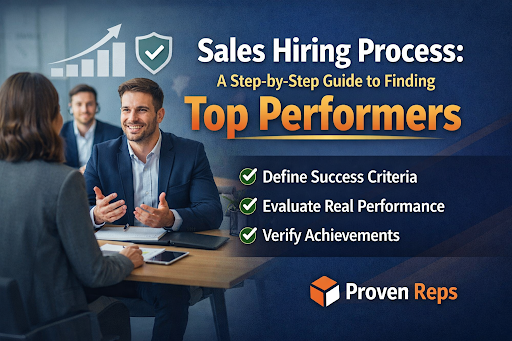
# Sales Hiring Process: A Step-by-Step Guide to Finding Top Performers
Hiring great salespeople is one of the most impactful decisions a company can make. The right hire can accelerate revenue, improve team morale, and create long-term growth, while the wrong hire can drain resources, damage pipeline momentum, and cost far more than just salary.
Yet many companies still rely on outdated or inconsistent hiring methods. They prioritize interviews over performance, personality over proof, and intuition over data. This is exactly why the sales hiring process needs a structured, repeatable approach.
In this guide, we break down a practical, step-by-step framework to help you attract, assess, and hire top-performing sales talent. We also explore how modern verification-driven platforms like Proven Reps are changing the way businesses evaluate candidates.
## Why Most Sales Hiring Processes Fail
Before we get into the process, it is important to understand where most companies go wrong.
Many hiring teams focus heavily on interviews. They evaluate confidence, communication, and cultural fit. These factors matter, but they do not guarantee performance.
Sales is a results-driven function. Yet most hiring decisions are based on conversations rather than verified outcomes.
Here are the common gaps:
- Over-reliance on resumes that highlight responsibilities, not results
- Lack of structured evaluation criteria
- No verification of claimed achievements
- Hiring based on gut feeling instead of data
This creates a disconnect between what candidates say and what they actually deliver on the job. A strong sales hiring process fixes this by aligning hiring decisions with measurable performance.
## 5-Step Process for Finding Top Sales Performers
### Step 1: Define What a Top Sales Performer Looks Like
This step is often skipped, but it is foundational. Before you start sourcing candidates, you need clarity on what success looks like in your organization.
Prior to hiring a sales representative, define both quantitative metrics and qualitative traits:
**Quantitative metrics:**
- Quota attainment percentage
- Average deal size
- Conversion rates
- Pipeline generation
**Qualitative traits:**
- Prospecting ability
- Objection handling
- Closing skills
- Adaptability
Clarity at this stage ensures that your hiring process stays aligned with business outcomes.
### Step 2: Source Candidates Who Can Prove Their Track Record
Once you know what you are looking for, sourcing becomes more targeted. And this is where most companies run into a structural problem. Standard job boards and recruiter databases surface candidates based on keywords, titles, and years of experience. None of those proxies tells you whether someone actually hit quota.
Platforms built around verified performance data change that equation. Instead of sorting through unverified resumes, you can browse candidates whose quota attainment and revenue achievements have already been authenticated through multiple data sources.
This is the model behind [Proven Reps](https://provenreps.com/), a platform that uses multi-source verification and proprietary benchmarking to validate sales performance before a candidate ever enters your pipeline. For recruiters, this means less time screening and more time evaluating candidates who have already proven they can deliver.
### Step 3: Screen for Specifics, Not Stories
The early stages of the sales hiring process are typically dominated by conversations about experience and personality. Candidates are good at talking about what they have done. The challenge is separating the ones who actually did it from the ones who were simply present when it happened.
Structured screening calls change the dynamic. Here are a few examples:
- What was your quota in your most recent role, and what percentage did you attain over the past three years?
- What was your average deal size, and how did that compare to your team's average?
- What was your ranking within your sales team for the past two years?
- Can you walk me through a deal you closed in the last six months, including how you sourced it and what the close process looked like?
Strong candidates can answer these questions with precision. They remember their numbers because their numbers mattered to them. And candidates who struggle to recall specifics, or who give ranges so wide they are essentially meaningless.
So, document every answer. You will use these claims as the basis for verification in the next step.
### Step 4: Verify Performance Before You Invest in the Interview Process
Most companies put verification at the end of the hiring process as part of a reference check. That is the wrong order. By the time you call references, you have already spent hours interviewing someone, built internal alignment around them as a candidate, and created momentum toward an offer.
Move verification earlier. Before you bring a candidate into a multi-round interview process, validate the claims they made in your screening call. This includes:
- W-2 verification to confirm earnings history and commission patterns
- Quota attainment data from previous employers or verified third-party sources
- Performance rankings or awards that can be cross-referenced
- Revenue figures benchmarked against industry standards for role and company size
In the sales hiring process, implementing this step can save a lot of time and resources from hiring the wrong sales professional.
### Step 5: Verify Achievements and Track Record
This is the step that most hiring processes overlook. Candidates often present impressive achievements, but without verification, it is hard to know what is accurate.
Verification adds a layer of trust and credibility.
You can verify performance through:
- Reference checks with past managers
- Reviewing CRM data or reports
- Using verified platforms like Proven Reps
When achievements are validated, you reduce hiring risk significantly. This is especially important in sales, where performance directly impacts revenue.
## The Compounding Value of Hiring the Right Candidate
The sales hiring process is not just about filling a seat. It is about building a repeatable system for finding and placing people who will drive revenue. Every good hire makes the next one easier. It adds to your culture, creates internal benchmarks for what top performance looks like, and builds the kind of team that top performers want to join.
The inverse is also true. A single bad hire taxes the system in ways that extend far beyond that person's tenure. Management time, team morale, and customer relationships all absorb the cost.
Sales professionals who are consistently hitting their numbers also face a related challenge on the other side of this equation. In a world full of inflated claims and AI-polished resumes, proven performance often goes unrecognized. For more on that dynamic, see our piece on [**why top sales reps struggle to stand out**](https://provenreps.com/blog/why-top-sales-reps-struggle-to-stand-out-even-with-great-numbers)
## How Proven Reps Improves the Sales Hiring Process
Traditional hiring methods leave too much room for guesswork. This is where Proven Reps stands out. Instead of relying solely on resumes and interviews, it focuses on verified performance data.
Here is how it helps:
- Candidates showcase measurable sales achievements
- Performance claims are validated
- Recruiters get access to data-driven profiles
- Hiring decisions become faster and more accurate
This approach reduces hiring risk and improves the quality of hires. If you want to explore this further, check out [How Proven Reps Work for Recruiters](https://provenreps.com/recruiters).
## Conclusion
Recruiting salespeople well is genuinely hard. The candidates who are best at selling themselves are not always the ones who are best at selling your product. The sales hiring process needs to be built around evidence, not impressions.
That means defining success before you post, sourcing candidates with verified track records, moving verification earlier in the process, and structuring every stage around data rather than gut feel. When you do that consistently, you stop hiring the best interviewer in the room and start hiring the best rep for your team.
If you are ready to bring that level of rigour to your next sales hire, Proven Reps is built exactly for that.

##### Maureen Biologist
Aliquam et tortor pulvinar, auctor neque sed, finibus quam. Praesent gravida bibendum justo, et suscipit urna ornare sed. Etiam metus lacus, blandit ut urna in, commodo elementum arcu. Maecenas sodales eget eros et commodo. Suspendisse laoreet auctor turpis non facilisis. Cras dolor libero,
Related Blogs
## Related Insights for Sales Success
[
](https://provenreps.com/blog/data-driven-sales-hiring-how-to-identify-top-and-real-sales-performers)
[Sales Recruiters](https://provenreps.com/blog/tag/sales-recruiters)
### [Data-Driven Sales Hiring: How To Identify Top and Real Sales](https://provenreps.com/blog/data-driven-sales-hiring-how-to-identify-top-and-real-sales-performers)
15 May, 2026
[Read More ](https://provenreps.com/blog/data-driven-sales-hiring-how-to-identify-top-and-real-sales-performers)
[
](https://provenreps.com/blog/resume-vs-reality-why-traditional-sales-hiring-methods-no-longer-work)
[Sales Recruiters](https://provenreps.com/blog/tag/sales-recruiters)
### [Resume vs Reality: Why Traditional Sales Hiring Methods No L](https://provenreps.com/blog/resume-vs-reality-why-traditional-sales-hiring-methods-no-longer-work)
15 May, 2026
[Read More ](https://provenreps.com/blog/resume-vs-reality-why-traditional-sales-hiring-methods-no-longer-work)
[
](https://provenreps.com/blog/why-most-sales-hires-fail-and-how-much-its-really-costing-your-business)
[Sales Recruiters](https://provenreps.com/blog/tag/sales-recruiters)
### [Why Most Sales Hires Fail And How Much It’s Really Costing Y](https://provenreps.com/blog/why-most-sales-hires-fail-and-how-much-its-really-costing-your-business)
15 May, 2026
[Read More ](https://provenreps.com/blog/why-most-sales-hires-fail-and-how-much-its-really-costing-your-business)
```json
{
"@context" : "https://schema.org",
"@type" : "BlogPosting",
"author" : {
"@type" : "Person",
"name" : "Maureen Biologist",
"url" : "https://provenreps.com/blog/author/maureen-biologist"
},
"dateModified" : "2026-05-15T06:01:33.740Z",
"datePublished" : "2026-05-15T06:01:33.000Z",
"headline" : "Sales Hiring Process: A Step-by-Step Guide to Finding Top Performers",
"image" : [ "https://provenreps.com/hubfs/provenreps_theme_jan_2026/images/Sales%20Hiring%20Process%20A%20Step-by-Step%20Guide%20to%20Finding%20Top%20Performers.png" ],
"mainEntityOfPage" : {
"@id" : "https://provenreps.com/blog/sales-hiring-process-a-step-by-step-guide-to-finding-top-performers",
"@type" : "WebPage"
},
"publisher" : {
"@type" : "Organization",
"logo" : {
"@type" : "ImageObject"
},
"name" : "Proven Resume Builder LLC"
}
}
```